
To be a Listed Building (LB) a building must:
“meet the criteria of special architectural or historic interest”
In their Technical, Advice & Guidance, Owner and Occupier Guide, Historic Environment Scotland (HES) states that a building can be defined as:
“anything made by people and can include a great variety of other structures such as fountains, sundials, statues and bridges”
The following post explores some of the attributes of LBs as encoded and described in HES’s listed building indicative GIS point data, CSV designations download and Historic Environment Portal search as of 19 May 2023.
Designations and entities
From the LB point data, LBs can be seen in terms of a designation applied to a building consisting of one or more entities, with the number of LBs changing regularly.
| 19 May 2023 | Description | Count |
| Designation (des_ref) | Listed building | 46,786 |
| Entity (ent_ref) | Structures | 67,361 |
The map below shows Hynish Harbour and Lighthouse Establishment and its associated 16 entities as an example of a LB designation with many and varied entities/structures.

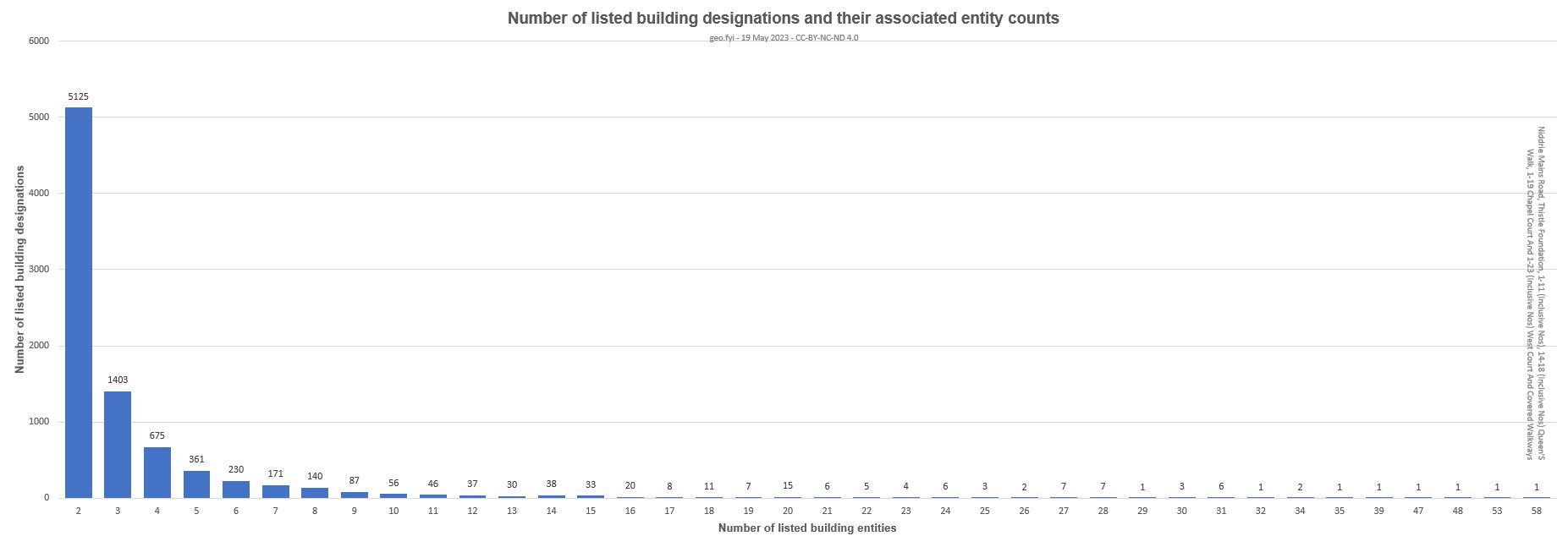
8,552 LB designations consist of more than one entity, with the Thistle Foundation having the most entities (58).
Time and geography
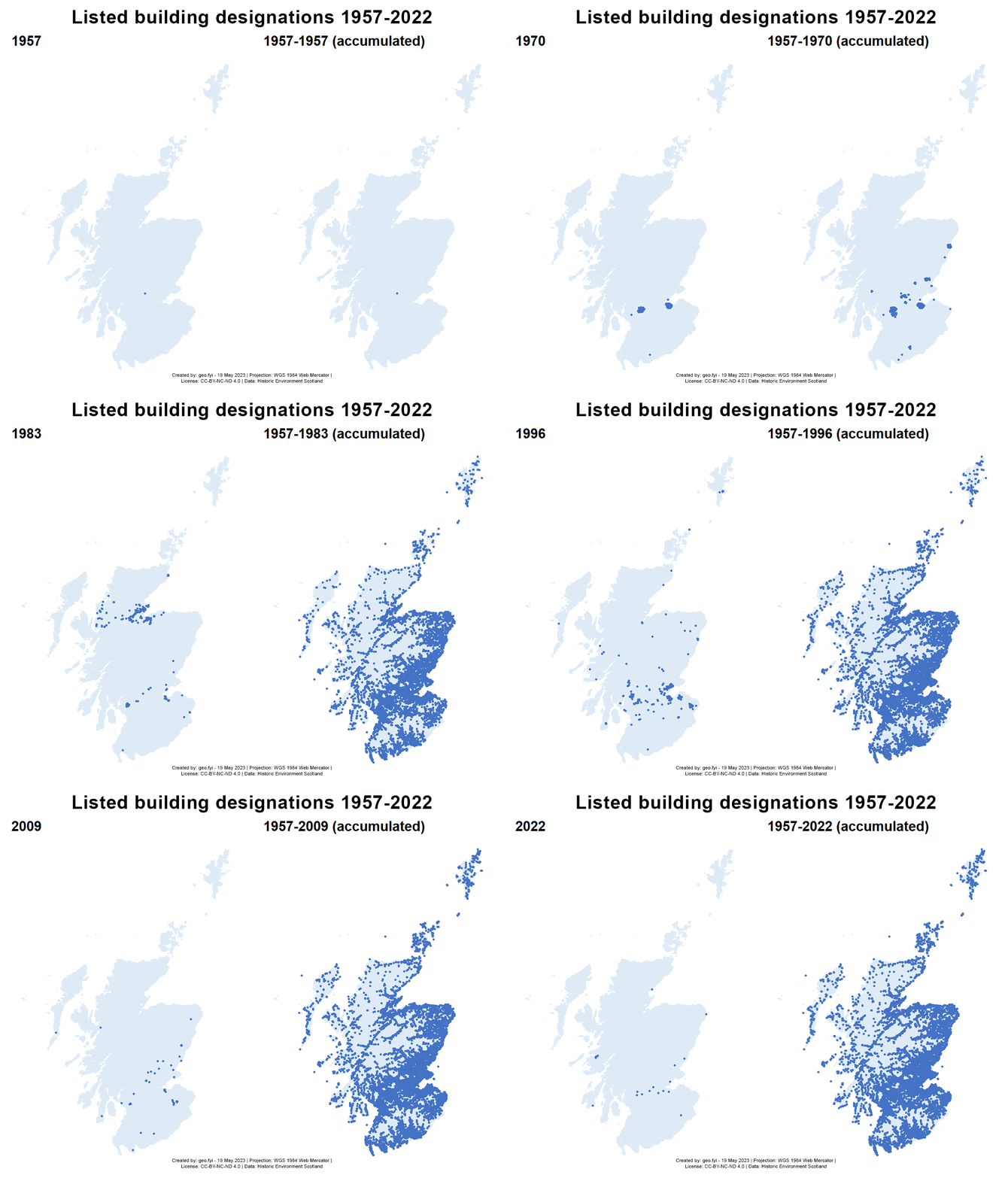
The number of LB designations per year (excluding removed LB designations) has varied, with the most LB designations having occurred in 1971.

The animation below shows the geographic distribution of LB designations over time (excluding removed LB designations).
See also: Listed Buildings of Scotland for geographic distributions of listed building entities.
Earliest
The earliest LB designations found were for the Scottish Churches House, Kirk Street, Dunblane on 02 April 1957, described as:
“Part of a row of largely 18th century houses, rescued from near demolition in the 1950’s.”
It consists of three listings for the entrance house, and south and north terrace. The latter becoming the first amended designation in 05 Oct 1961.

Image © RCAHMS
Latest
As of 19 May 2023 there have been four LB designations during 2023:
| Designation | Date and Location | Image |
| C LB52614 1 entity | 09 Feb 2023 124 Craighall Road, Glasgow City |  |
| C LB52600 2 entities | 08 Mar 2023 Killylung, Holywood, Dumfries and Galloway |  |
| B LB52612 4 entities | 03 May 2023 Eastriggs, Dumfries and Galloway |  |
| C LB52615 2 entities | 03 May 2023 Bushelhead Road, Braidwood, South Lanarkshire |  |
Category
LB designations are grouped into three categories of examples of a particular period, style or building type of special architectural or historical interest:
| A | outstanding examples |
| B | major examples |
| C | representative examples |
The chart below shows the proportion of LB designations in each LB designation category per year (excluding removed LB designations).

See also Scotland’s City Centre Listed Building Footprints.
Amendments and removals
Amendments
There have been a number of LB designation amendments (excluding removed LB designations), particularly since 2015.

Removals
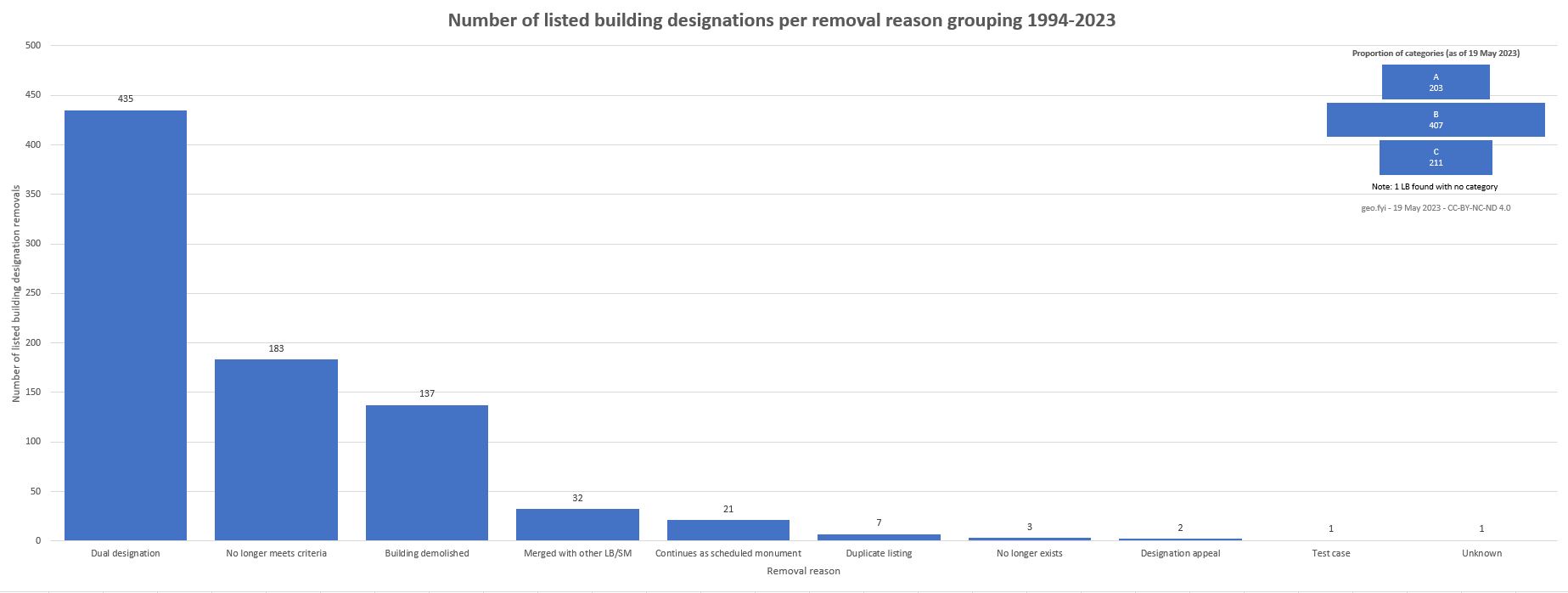
Information on removed LB designations is not available in the listed building point GIS data. Therefore, the CSV designations download was used to identify 822 removed LB designations and their URLs. These URLs were then used to programmatically web scrape the Historic Environment Portal to extract the LB’s designation removal date, reason for removal and coordinates.

As of 19 May 2023 there have been 8 LB designation removals during 2023.
Reasons for LB designation removal were grouped and mapped.

 geo.fyi
