
Listed buildings are:
“buildings of ‘special’ architectural or historic interest enrich Scotland’s landscape and help chart our history.”
Listings are carried out by Historic Environment Scotland (HES) and is a process that:
“identifies, designates and provides statutory protection for buildings of ‘special architectural or historic interest’, as set out by law in the Planning Listed Buildings and Conservation Areas (Scotland) Act 1997“
Information on Scotland’s 46,750 listed buildings and their associated 67,301 entities (structures) is made available via the Historic Environment Scotland Portal, a map search and GIS data download. Listed buildings are also represented in the National Record of the Historic Environment.
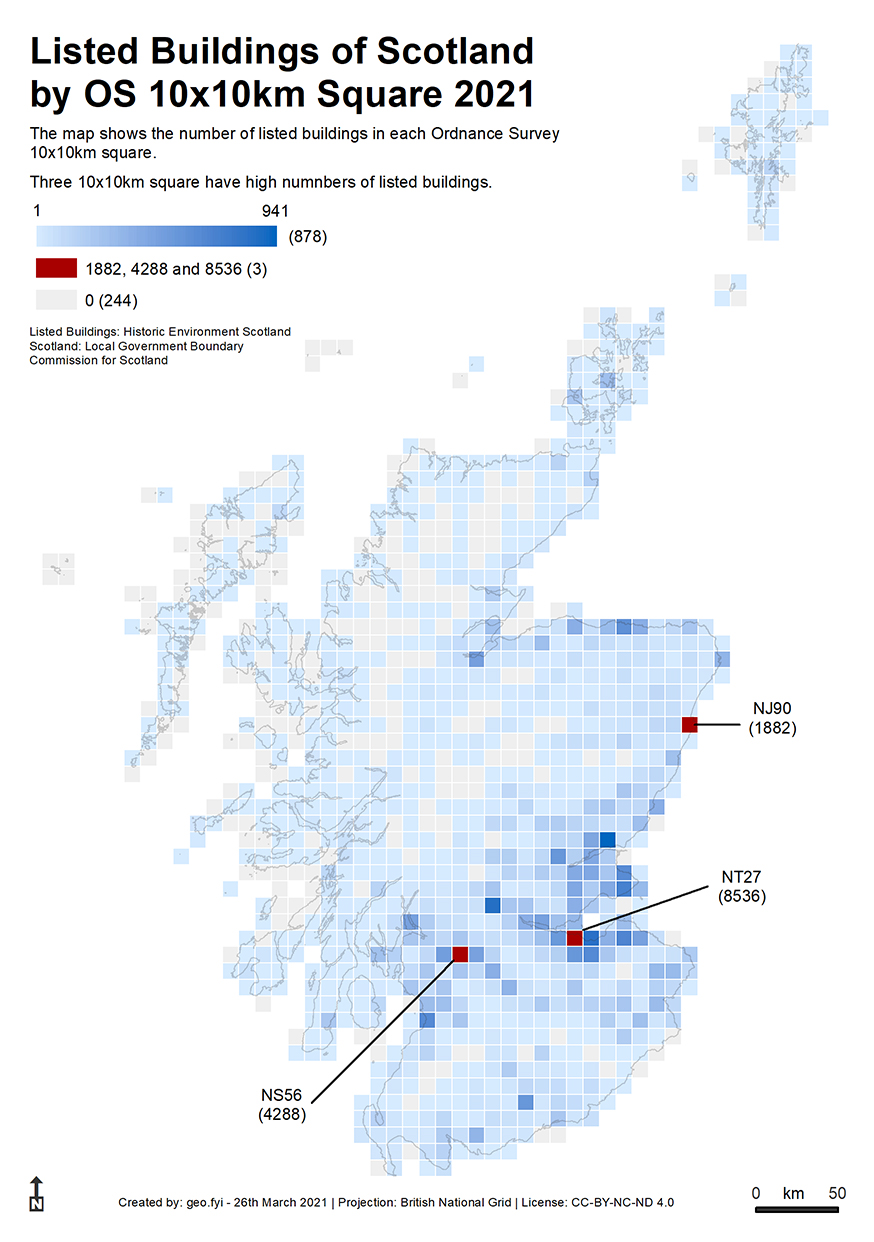
The following maps explore the distribution of the 67,301 listed building entities/structures across Scotland.
Distribution of Scotland’s listed buildings
At the 10km2 perspective listed buildings have a similar distribution as scheduled monuments. The three 10km2 squares with the highest number of listed buildings identify the centers of Aberdeen, Edinburgh and Glasgow with the latter two cities also being surrounded by high density 10km2 squares. Other cities are also identifiable.
From an urban, small town and rural perspective:
– Listed building entities are found equally in large urban and accessible rural areas.
– The highest density of listed building entities is found in large urban areas.

The map below shows a distribution of listed building entities by Data Zone. Most of Scotland has a low to medium number of listed building entities per Data Zone. Data Zones with a high number of listed building entities, are not visible due to their compact size.
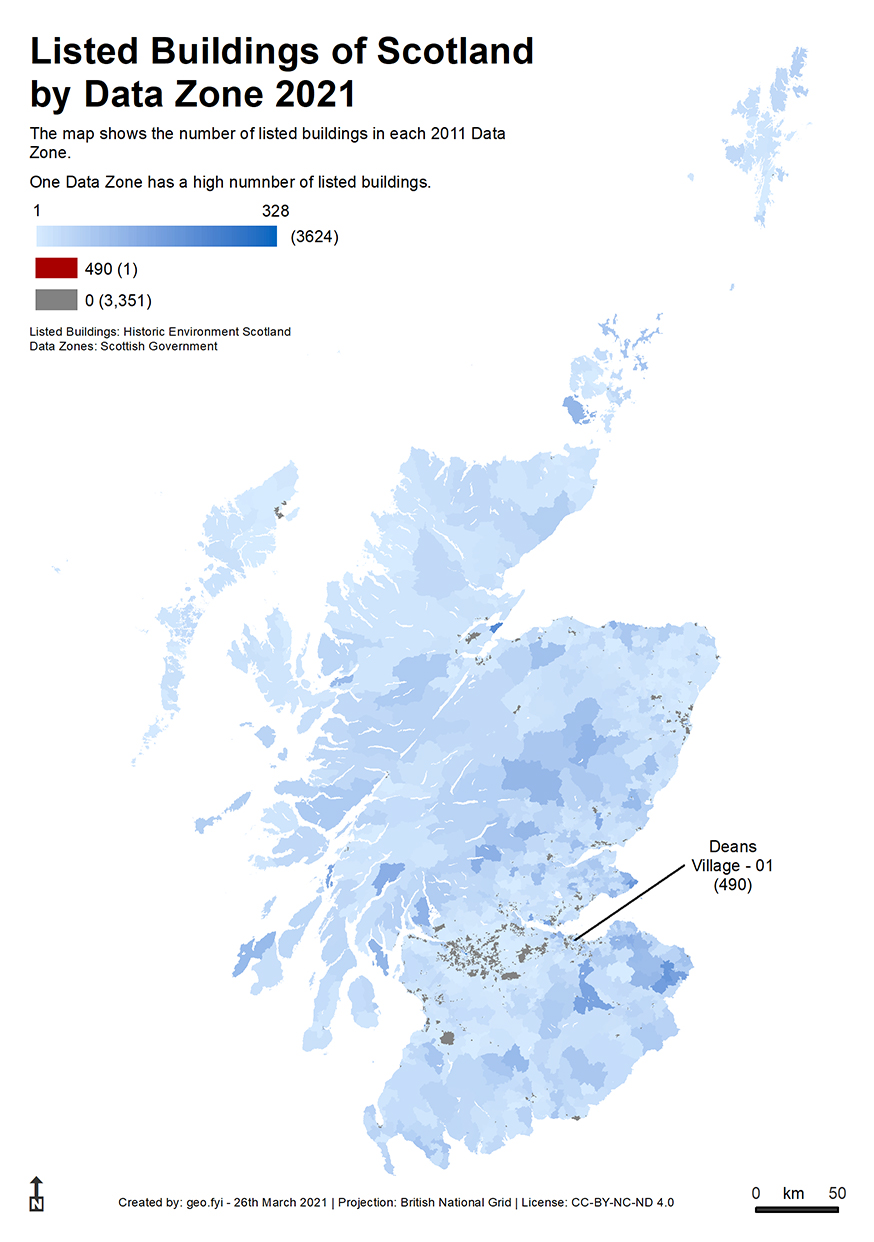
Looking at the listed building entity density in Data Zones, the map below shows that at a country scale the majority of Scotland has Data Zones with less than one listed building entity per square kilometer. Data Zones with 0 or more than one listed building entity per square kilometer are found in close proximity to each other on the east coast and in the central belt of Scotland.
Both Edinburgh and Glasgow show a concentration of listed building entities approximately in their city centres which are surrounded by a ring of Data Zones without listed building entities. Glasgow’s ring of Data Zones without listed buildings being more substantial than Edinburgh’s.

From a local authority perspective the number of listed building entities is highest in the City of Edinburgh, with Fife having the second highest. Other than Edinburgh and Glasgow, local authorities in the central belt have a low number of listed building entities along with Shetland Islands and Na h-Eileanan Siar.

 geo.fyi