
Scotland is divided into 18 Broad Rental Market Areas (BRMAs) with a BRMA defined as an area:
“within which a person could reasonably be expected to live having regard to facilities and services for the purposes of health, education, recreation, personal banking and shopping, taking account of the distance of travel, by public and private transport, to and from facilities and services of the same type and similar standard“
In addition, a BRMA should contain two or more distinct areas of adjoining residential accommodation with residential premises of a variety of types and tenancies.
Empowered by the Welfare Reform Act (2007) and the Rent Officers (Housing Benefit Functions) (Amendment) Order 2008, Scotland’s BRMA boundaries came into force on January 5th, 2009.
Current Scottish BRMAs
The map below shows the current BRMA boundaries for Scotland.
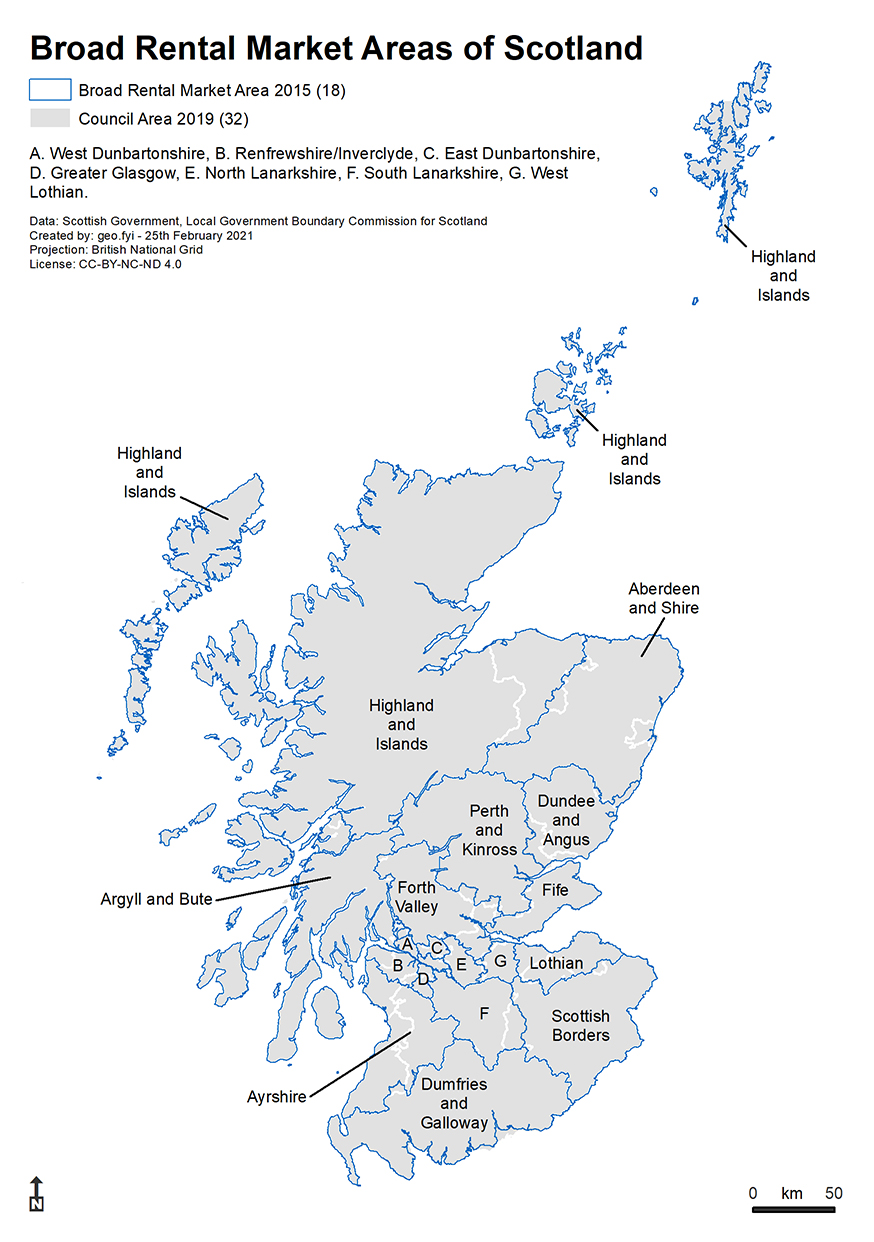
It can be seen from the map that in general BRMAs do not coincide with council areas boundaries. The metadata associated with the BRMA boundary data discusses this:
“Although BRMA boundaries were not required to follow pre-existing social geographies, it was decided they should conform to postcode geographies for utility. It was not however possible to achieve all the desired splits with postcode sector boundaries therefore BRMAs can be seen as aggregations of postcode units.”
Look ups to lower level geographies such as postcodes, census output areas and data zones are available.
BRMAs and Local Housing Allowance
A selection of rents in a BRMA are used to determine the Local Housing Allowance (LHA) rates for each category of housing in a BRMA, the exact calculation of an LHA rate having evolved over time.
Rent Officers from Rent Service Scotland set a fair rent level based on a range of information about a property including distance of travel, by public and private transport, to and from services and facilities. Fair rents are then registered at the Register of Fair Rents.
The Valuation Office Agency provides a UK wide LHA search service by post code or local authority.
Criticism of BRMAs
In 2009-10, a Work and Pensions select committee report stated:
“the BRMA calculation is one of the least transparent, nobody can understand it. It is an absolute nightmare to try and explain to somebody how the boundary was drawn in that way”
and cited the Shelter England’s 2009 research briefing which found that:
“BRMA boundaries used for setting LHA are working contrary both to the aims of housing benefit reform and to wider government initiatives, such as creating mixed communities and maximising employment and training incentives for benefit claimants.”
In 2011, A SPICe briefing entitled Housing Benefit Changes – Implications for Scotland stated that the Social Security Advisory Committee recommended that the UK government review the BRMAs.
The UK Government response was:
“Although Broad Rental Market Area boundaries will remain broadly as they are in the short term… one option that the Government is keen to explore is whether areas could be co-aligned with local authority boundaries”
In 2018, in An Evaluation of Rent Regulation Measures within Scotland’s Private Rented Sector, Shelter Scotland stated:
“How the BRMA boundaries are arrived at still remains clouded in some mystery, and is one of the least transparent aspects of the current Social Security system”
Nonetheless it was recognised that
“BRMAs are ultimately defined by Rent Officer judgement”
but
“the current geographic unit employed cannot support statistical reporting at local authority and small area level”
and
“it was not evident how, or even if, Rent Officers employ the 2011 Census as a benchmark to help them ensure a proportionate spread of data, by property type and geography.”
Given that Northern Ireland has reviewed it’s BRMAs it was suggested that
“the current size of the Scottish ones should also be reviewed”
In a 2019 report submitted by Shelter Scotland to the Social Security Committee of the Scottish Parliament it stated that:
“It could be argued that the use of Broad Rental Market Areas (BRMAs) as the administration levels for setting LHA rates is flawed and outdated”
Lothian BRMA was cited as a perfect example of this:
“…the large size of BRMAs has always caused major problems within high rent pockets in otherwise low market areas. Rent in Edinburgh is considerably higher than other areas included in the Lothians region, meaning that the LHA level is skewed by this mixture of data.”
A Social Security Support for Housing session, raised Shelter’s comments directly with the Department of Works and Pensions (DWP), asking if it had any plans to review BMRAs in Scotland. The response was:
“We have no plans to review the broad rental market areas… If we were to change them, we would find that there would be significant losers as well as winners”
In addition, the session asked whether Scottish Minsters could use their Universal Credit (UC) powers to amend LHA rates and BRMA boundaries. The response addressed LHA rates but not BRMA boundaries:
“The Scotland Act 2016 powers give us some flexibility in how the universal credit housing costs element is calculated, but using those powers to change LHA rates would be very challenging in practice.”
Changing BRMA boundaries
Given the above criticisms of BRMAs and that BRMAs are instrumental in setting LHAs, being able to change their boundaries is of importance.
In 2017, the Valuation Office updated its 2012 guidance on what constitutes a valid reason to review a BRMA, stating that rent officer/managers should have a BRMA review programme and local authorities can request a BRMA review.
Valid reasons for BRMA reviews are based around significant change to the:
– Provision of facilities and services for health, education, recreation, personal banking and shopping
– Transport infrastructure
– Variety of housing types and tenures
– Size of the private rented sector
and as an example, Action 42 of Glasgow’s Housing Strategy 2017-2022 is to:
“Recommend to the Scottish Government that they carry out a review of BRMAs in Glasgow to reflect the rapid increase in the private rented sector in the city”
According to Article 3 of The Rent Officers (Universal Credit Functions) Order 2013 (amended in 2020) and the LHA Guidance Manual 2014:
“Rent officers are required to review the BRMA as often as it is thought appropriate, but all suggested changes to BRMA boundaries are subject to the agreement of the Secretary of State.”
In addition, the LHA Guidance Manual 2014 states that a judicial review is needed if a claimant wishes to request that a BRMA boundary be redrawn as part of an LHA appeal.
Scottish BRMA Boundary Changes
BRMAs are part of the Scottish Register of Geographic Codes and as such any changes to BRMA boundaries that result in a change to their BRMA codes should be logged in the Government Statistical Service (GSS) Code History Database.
In looking, none were found, suggesting that despite requirements for BRMA boundary review programs, Scottish BRMA boundaries have never changed.
However, the metadata associated with the BRMA boundary data states:
“A revision was made to the boundaries in July 2015 to correct the area of Oban, which had incorrectly been allocated to Highland and Islands BRMA, to be within the Argyll and Bute BRMA”
Whether or not there will be any changes to Scottish BRMA boundaries in the future remains to be seen.
 geo.fyi