
It has been five years since the United Nations adopted three landmark agreements.
1. The Paris Agreement on Climate Change
2. The Sustainable Development Goals of Agenda 2030
3. The Sendai Framework for Disaster Risk Reduction 2015–2030
The United Nations Office for Disaster Risk Reduction (UNDRR) and the International Science Council (ISC) recently published the Sendai Hazard Definition and Classification Review Technical Report with an aim to provide a common set of hazard definitions for monitoring and reviewing all three agreements.
The report calls for:
“a data revolution, rigorous accountability mechanisms and renewed global partnerships”
What is a hazard?
The United Nations General Assembly (UNGA) has adopted the following definition of a hazard:
“a process, phenomenon or human activity that may cause loss of life, injury or other health impacts, property damage, social and economic disruption or environmental degradation”
In addition, a hazard should:
1. Have the potential to impact the functioning of a community
2. Be manageable via proactive and reactive measures
3. Have measurable spatial and temporal components
Characterisation
The initial UNDRR/ISC hazard list includes 302 specific hazards grouped into 8 hazard types and described in the table below.
It is a baseline of knowledge of hazards rather than a prescribed list. Complex, compound and cascading hazards and underlying drivers such as climate change are excluded.
| Hazard Type | Definition |
|---|---|
| Meteorological and hydrological hazards | Resulting from the state and behaviour of the Earth’s atmosphere, its interaction with the land and oceans, the weather and climate it produces, and the resulting distribution of water resources. |
| Extraterrestrial hazards | Originating outside the Earth, such as asteroid and meteorite impacts or solar flares. |
| Geohazards | Resulting from the Earth’s internal geophysical processes (seismologic and volcanogenic) and from surface or near-surface processes. |
| Environmental hazards | Arising through degradation of the natural systems and ecosystem services (air, water, land, biodiversity and earth processes) upon which humanity depends. |
| Chemical hazards | Arising from the use or misuse of industrial, agricultural and transport related chemicals. |
| Biological hazards | Arsing from the natural, deliberate or unintentional release of pathogenic microorganisms, toxins and bioactive substances. |
| Technological hazards | Arising from the possibility of failure of an existing technology as well as from emerging technologies i.e. land, sea and air transport systems, radiation, nuclear materials, unlocated explosives, mining activities and essential ICT services |
| Societal hazards | Derived from socio-political, economic activity, cultural activity and human mobility and the use of technology, but also of societal behaviour – either intentional or unintentional. |
Hazards and disaster risk
Hazard information is used along side the following to calculate disaster risk:
1. Exposure – assets of interest and at risk (such as the environment, the economy, buildings, or people)
2. Vulnerability – susceptibility of assets to damage or impact from a hazard
3. Capacity – combination of all the strengths, attributes and resources available within an organisation, community or society to manage and reduce disaster risks and strengthen resilience.
The report recognises the need for a more systematic approach and characterisation of hazards so as to better inform risk reduction and management.
Hazards and disasters
The following charts visualise data on hazards and disasters from the World Disaster Report 2020: Come Heat or High Water published by the International Federation of Red Cross and Red Crescent Societies (IFRC).
The hazard classification used is similar to but not explicitly aligned to the initial list of the UNDRR/ISC report.
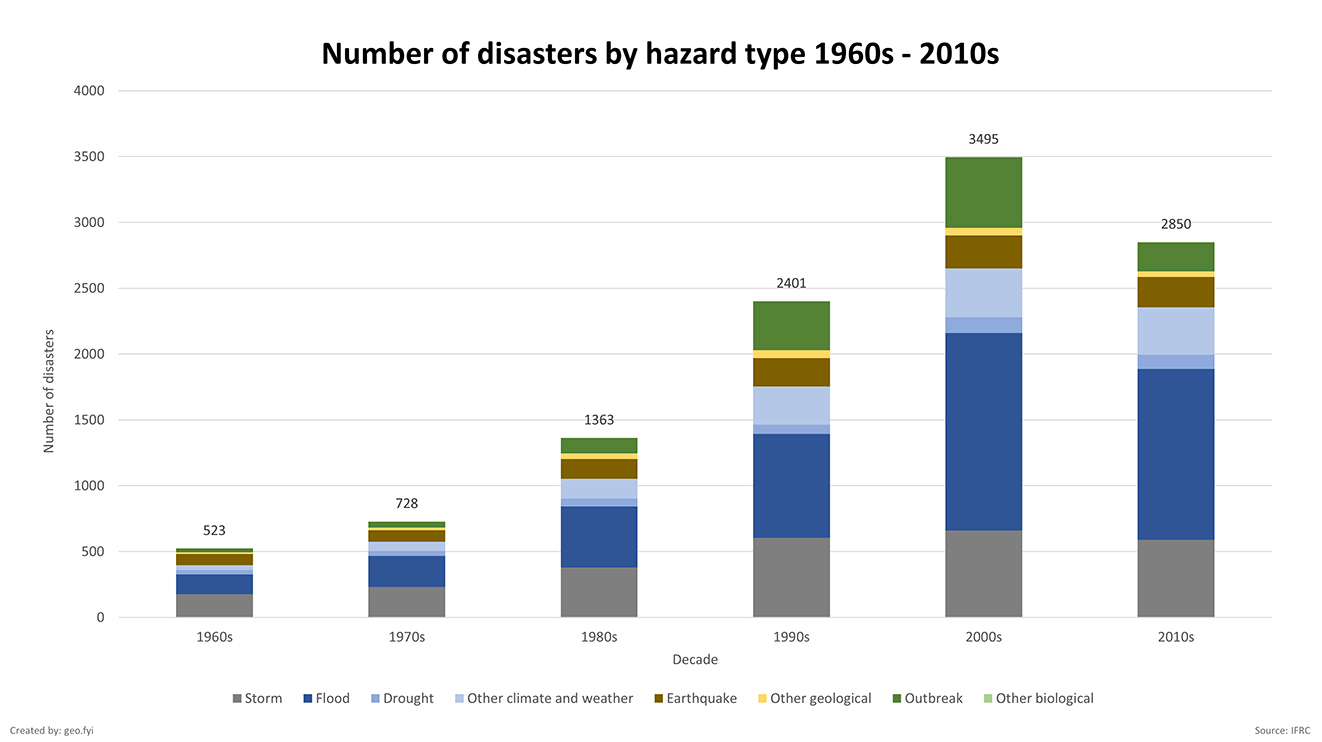
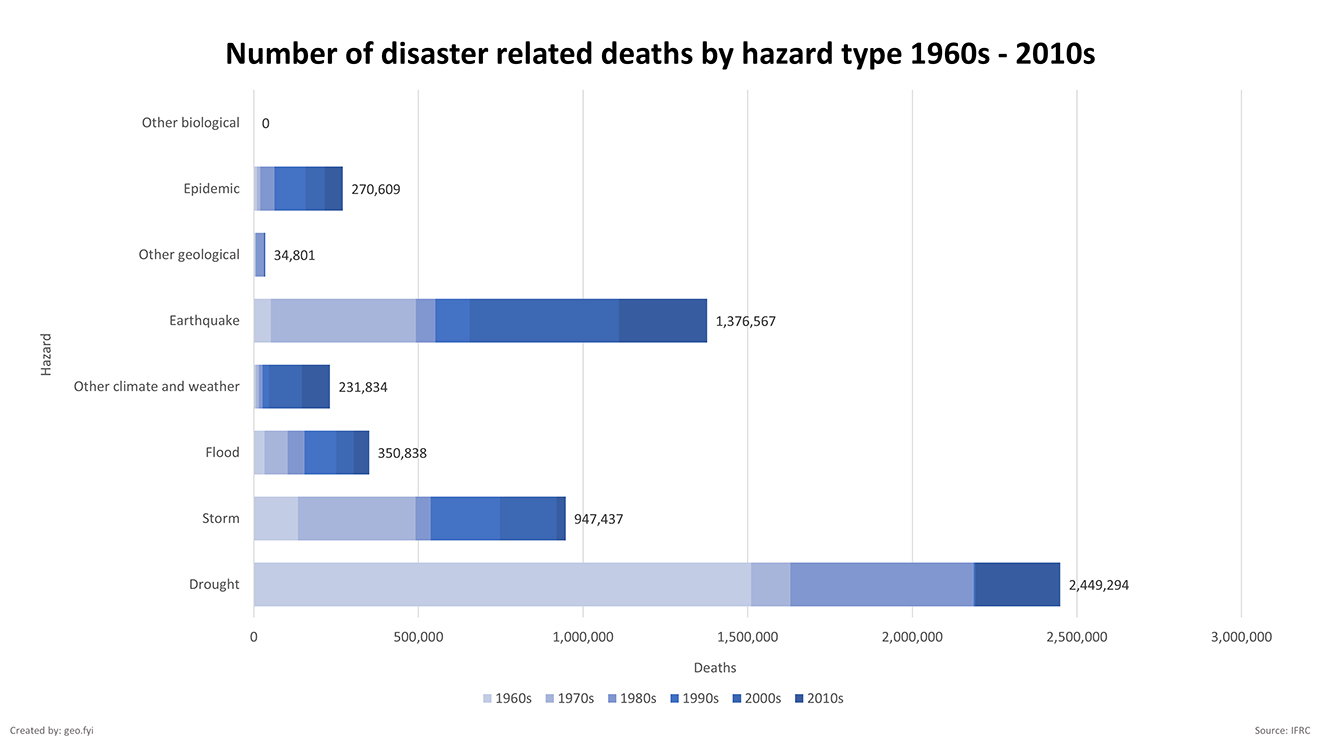
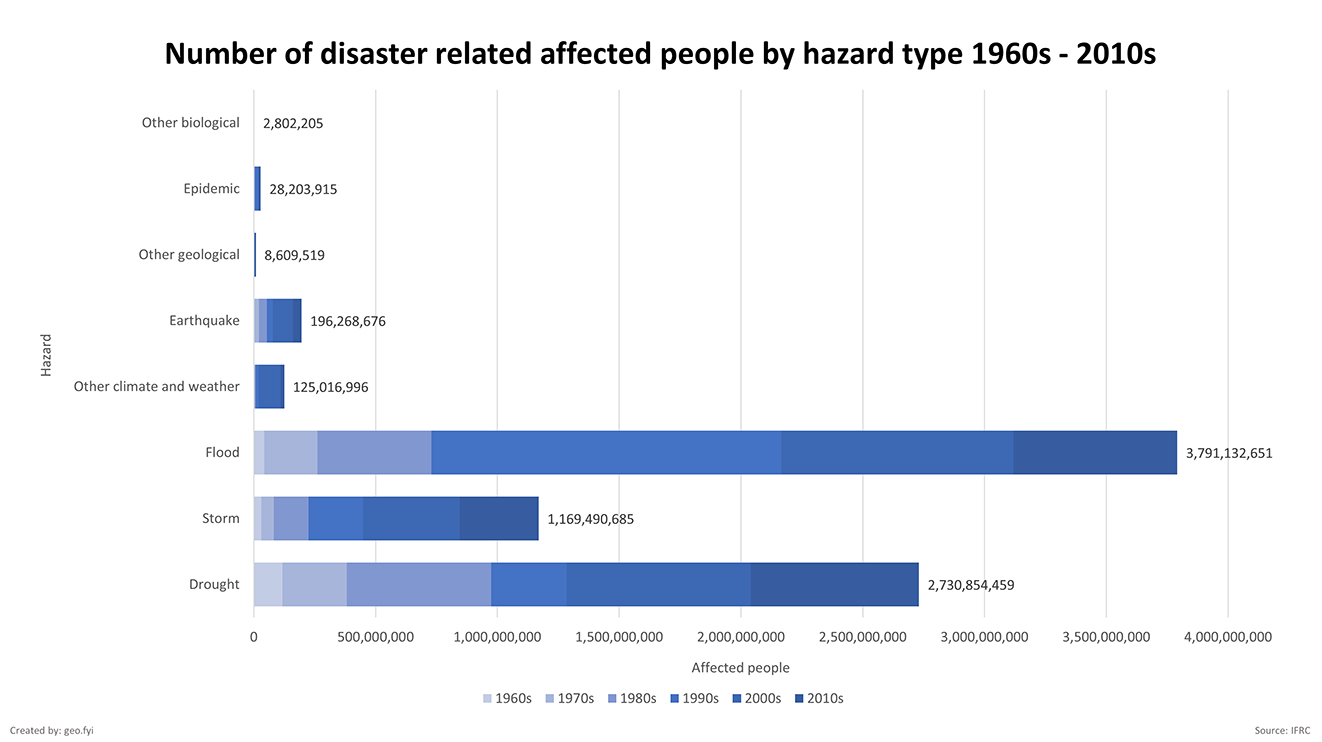
People have been counted more than once if affected multiple times by a disaster.
 geo.fyi
Excellent report by the IFRC. Good share and good read
LikeLike