
This month the African Child Policy Forum (ACPF) published the 6th report in their African Report on Child Wellbeing (ARCW) series, with the 2020 edition theme being “How friendly are African governments towards girls?“.
Previous reports and their themes were:
2008 – How child-friendly are African governments?
2011 – Budgeting for children
2013 – Towards greater accountability to Africa’s children
2016 – Getting it right: bridging the gap between policy and practice
2018 – Progress in the child-friendliness of African governments
Child rights and child-friendly government
African governments are obliged to respect, protect and fulfil child rights under the United Nations Convention on the Rights of the Child (UNCRC) and the African Charter on the Rights and Welfare of the Child (ACRWC). The ACPF takes a rights based approach to measure the the child-friendliness of a government and define a child friendly government as:
“one that is making the maximum effort to meet its obligations to respect, protect and fulfil child rights, and ensure child wellbeing.”
Child-friendliness index (CFI)
The ACPF creates a ranked CFI of African countries to track their ACRWC compliance. It is based upon indicators associated with three dimensions of child rights:
Protection – assessed in terms of the legal and policy frameworks the government has put in place
Provision – assessed in terms of budgetary expenditure on programmes targeting children and their effectiveness in achieving child wellbeing outcomes.
Participation – assessed in terms of government efforts to promote child participation in decisions that affect them.
The French overseas departments and regions of Mayotte and Reunion and the United Kingdom overseas territory of Saint Helena are not included.
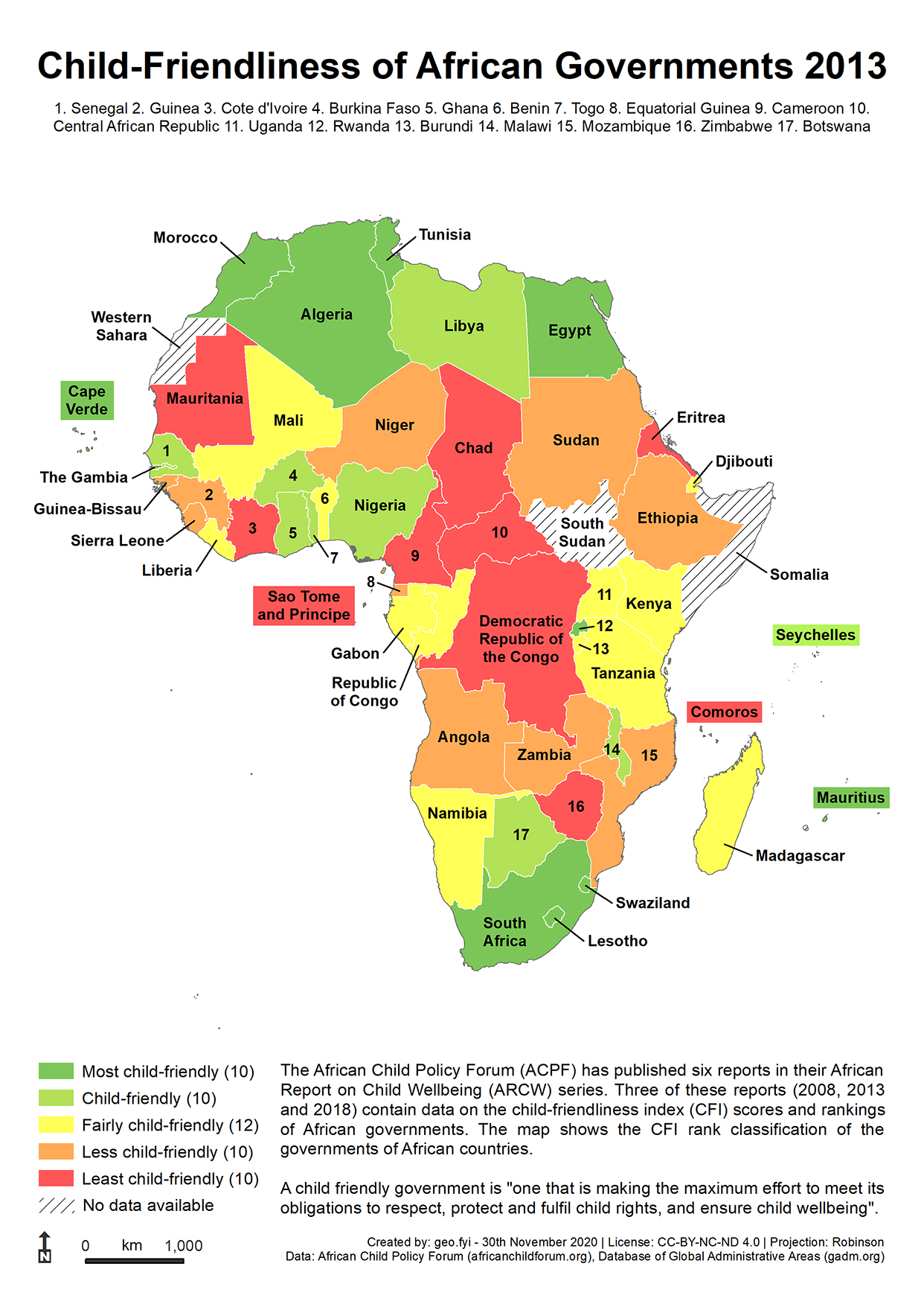
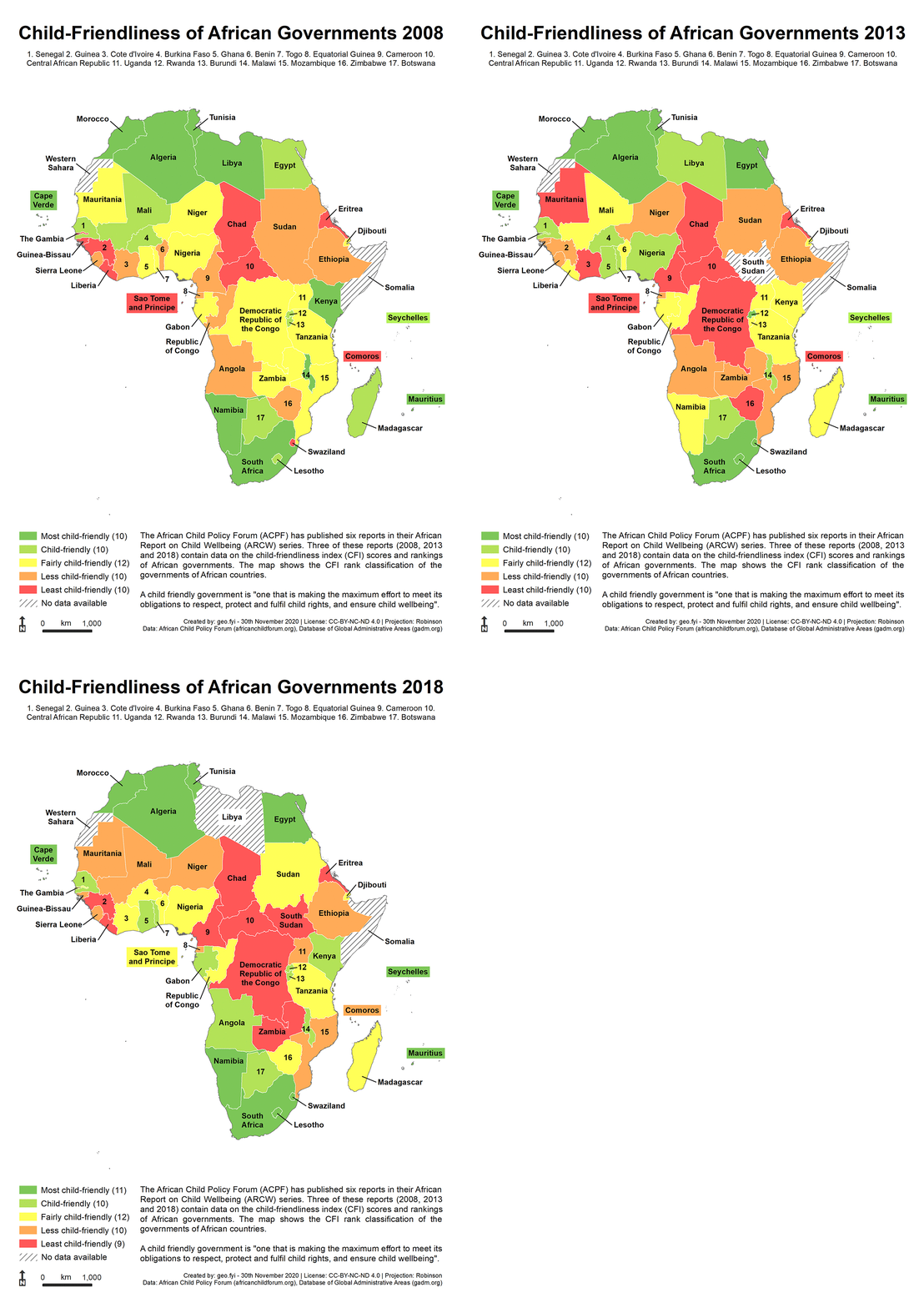
The following maps show the CFI rank classifications of African governments for 2008, 2013 and 2018. An animated time series map is also included.
2008
ACPF calculated their 2008 CFI using available indicators from predominately 2004 data and in some cases 2005 data. Legal and policy indicators were available for 2007.

2013
Although individual countries moved up and down the CFI rankings in 2013 compared with 2008, ACPF noted an average increase of ~11.5% in African governments CFI scores due to improvements in child protection and budget allocations.
In South Sudan it became difficult to obtain suitable data.
2018
Libya has joined Somalia and Western Sahara (and Sahrawi the Arab Democratic Republic) in being difficult to obtain suitable data.

2008-2018 time series animation
 geo.fyi